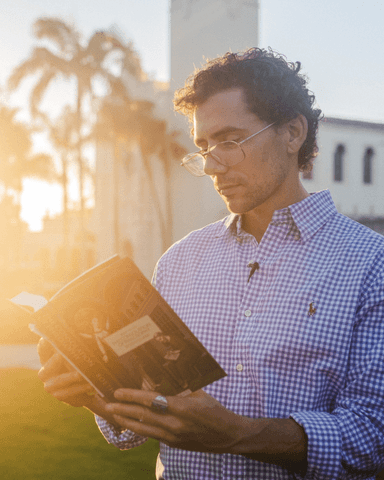
Joshua Beneventi reading

What I write.

Six books, one argument — and a writer who came to it the long way round.

I started as a reader under the bedsheets — the Bible, illuminated manuscripts, Homer — convinced there was something in those pages I was supposed to find. Anthropology gave me the first tool: most of what we take for reality is a learned script. The traditions gave me the rest. I have sat six months in Thai monasteries, kept company with Sufis in Andalusia and the Levant, read manuscripts at St. Catherine’s on Sinai, and gone down on one breath into the Red Sea. The books are where all of that goes.
I write the way I was trained to look: field first, sources second, argument last. Every book here is built on primary texts read in the original where I can and footnoted where I can’t, on time spent with living practitioners of what the books describe, and on a rule I hold harder than any thesis — that when traditions rhyme, the rhyme is evidence about the pressure they were under, not proof that they descended from one another. I would rather a book be true in the particulars and modest in its claims than the reverse.
Two threads run under all six. One is historical: the West inherited Rome’s disposition, not Greece’s — the administrator’s eye rather than the initiate’s — and much of what the books recover is what that inheritance set aside. The other is structural: at every scale the books examine, a form can be built to be generative, returning more to its parts than it draws from them, or extractive, feeding a center. The same distinction, traced through eros, the self, the place we live, and the civilizations we belong to.
Manuscript complete

Born AgainThe Human Rite of Rebirth

You are not the same person who started this sentence. The self you take for a fixed thing is a construction — assembled late, in language, over an older mode of being that never stops running underneath — and nearly every culture that ever lived discovered that a self, once built, can be taken apart and grown again. They called it a death and a birth.

From the Candomblé terreiros of Bahia to the drums of the Siberian taiga, Born Again is a field report on humanity’s oldest technology: the deliberate unmaking and remaking of a person, in company and on purpose. It is dangerous alone and generative when held — and a civilization that has forgotten how to do it still needs it, and meets it unprepared. Not a lament for what was lost, but a map of a living art, and an argument that the remaking is coming for you whether or not anyone has handed you a way to meet it.


In draft

Fate of the Middle World

Between the human and the divine, every culture but ours kept a middle world — thronged with daimons, angels, ancestors, and intermediary powers that carried messages both ways. The modern West is the civilization that emptied it: it turned the daimon into a demon, then into a delusion, and called the disenchantment progress.

But the middle did not die; it went underground and came back wearing new clothes — in fantasy and games, in the crowds that still worship, in the synthetic minds we are now building to talk to. Fate of the Middle World is a philosophical reckoning with what was expelled and what is returning, and with the harder question the return forces: not whether to re-enchant, but how to tell a bridge from a trap. Its answer is not a vibe but a virtue — discernment, the lost art of the between.


In draft

EudaimoniaThe Good Life

What is a good life? The oldest Western answer hides inside a word we have flattened into “happiness”: eudaimonia — a good daimon, a well-tuned spirit. Not a feeling to chase but a life lived in the right proportion, the ancient mean between too much and too little.

Ranging from Aristotle’s ethics to a full-moon night of strangers’ hospitality in the Azores, from the tyranny of a life spent killing time to the quiet economics of needing little, Eudaimonia asks what it would take to live well now — competent in the system, free of its anxieties, awake to beauty and to other people. It offers not a formula (the good life resists being made one) but a lens: the disposition of a soul tuned like an instrument, and the craft of keeping it in tune.


Manuscript complete · seeking representation

UpstreamForming Human Beings in the Age of the Machine

The book page

Every crisis we treat downstream — in the clinic, the classroom, the courtroom, the workplace — was shaped upstream, by whether anyone was formed to meet it. Upstream is the case that formation, not education, is the infrastructure a humane civilization runs on: the drawing-out of judgment, character, and the capacity to mean and make, which every earlier civilization built deliberately and ours spent a century dismantling.

The door is the age of the machine. As AI commoditizes everything codifiable, the scarce currency is exactly what formation produces — and the book documents a living movement that never stopped producing it, from Grundtvig’s folk schools through Highlander and the civil-rights movement to the revival now under way. Its one load-bearing claim: universal architecture, particular vocation. Build the capacities every human needs; let each person discern their own calling inside them. The model is the midwife and the gardener, not the molder and the engineer.


In development

Nomadic Universalismworking title

Why do peripheral, improbable groups sometimes overrun the world? The recurring answer is a form, not a virtue: a thin membrane of membership — cheap to join, defined by adherence rather than blood or soil — bolted to a hard, portable core, one non-negotiable protocol carried anywhere. Islam and the United States are the two fullest experiments, a millennium apart.

But the same open form that incorporates can also extract, and this book refuses the triumphal story: the “low barrier to entry” was annihilation for those outside the membrane. It is a reckoning with the architecture of belonging at civilizational scale — how open protocols conquer, when they give life to their members and when they merely feed a center, and what a genuinely generative universalism would have to cost the people who build it.


Manuscript in revision

The Green MantlePlato and Islam

Long after the Latin West lost its Greek, the Platonic tradition found a second home in Islam — carried by philosophers and mystics who read Plato not as a dead pagan but as a fellow traveler toward the divine. But the two civilizations did different things with what they inherited. The West turned Platonism into a subject: something read, taught, and argued about. The Islamic world kept it as a practice: something undergone, a discipline of the soul with the ascent still in it.

The Green Mantle traces that hidden lineage — the imaginal world of the Sufis and the Persian sages, the marriage of Athens and the Qur’an, the mundus imaginalis Henry Corbin spent a life recovering — and makes the case that the standard history has the bridge backwards. Philosophy, for those who walked it, was itself a form of prayer; the book is an invitation to walk it again.

There is none that matters. Upstream is the most practical door and the one furthest along; Born Again is the most immediate. Essays and excerpts appear in the Library as the books move toward print.